Last updated: November 25, 2026
Synthetic data is algorithmically generated data that has the same structure as a real dataset and tries to keep its statistical properties, but is not made of real individuals’ records. Teams use it for AI training, software testing and sharing data when real records are scarce or sensitive. It does not automatically guarantee privacy, so it still needs quality and privacy checks.
Per NIST SP 800-226, a synthetic dataset looks like the original dataset in that it has the same schema and attempts to maintain its properties, such as correlations between attributes, but it consists of algorithmically generated data associated with fake individuals.
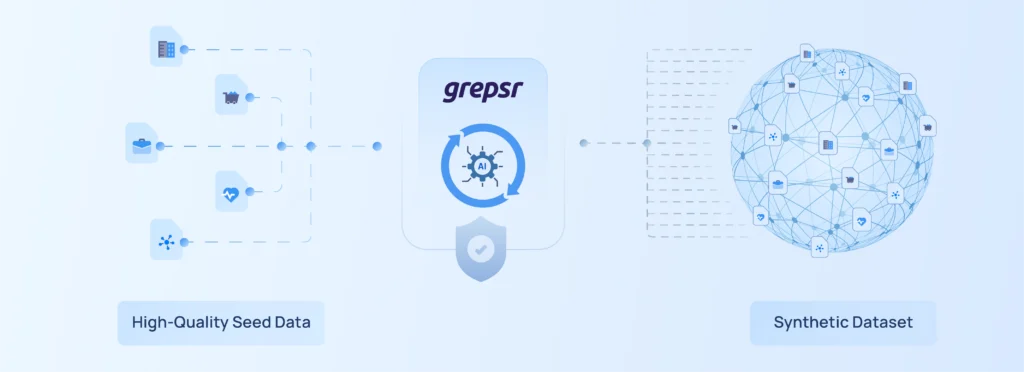
As data continues to shape innovation and decision-making, synthetic data is becoming more important. But what exactly is synthetic data, and why is it getting so much attention? In this article, we cover how it is created, where it is used, and what to check before relying on it.
What Is Synthetic Data?
Synthetic data is artificially generated data that mirrors the statistical properties of real-world data. It is designed to resemble actual datasets but is created algorithmically rather than collected from real-world observations.
Unlike anonymized or modified datasets, synthetic data is generated rather than altered from original records, and it tries to preserve underlying patterns, trends, and correlations. How much privacy protection it gives depends on how it is generated, so privacy risk should be tested, not assumed; see NIST SP 800-226.
Synthetic data can be used where real data is scarce, inaccessible, or too sensitive to share, such as in healthcare, finance, or AI model training.
Why does synthetic data matter?
- Privacy: synthetic data can reduce the need to share real records, but it does not remove privacy risk by itself. NIST SP 800-226 says techniques that do not satisfy differential privacy generally provide only informal privacy guarantees. Check privacy and regulatory requirements for your use.
- Innovation: synthetic data gives developers a lower-risk environment for testing and development, so they can try new algorithms, models, or technologies without exposing real records.
- Data accessibility: in many industries, high-quality data is hard to get because of regulatory constraints or scarcity. Synthetic data can provide representative datasets where real data is unavailable, if it is validated against real data.
How is synthetic data generated?
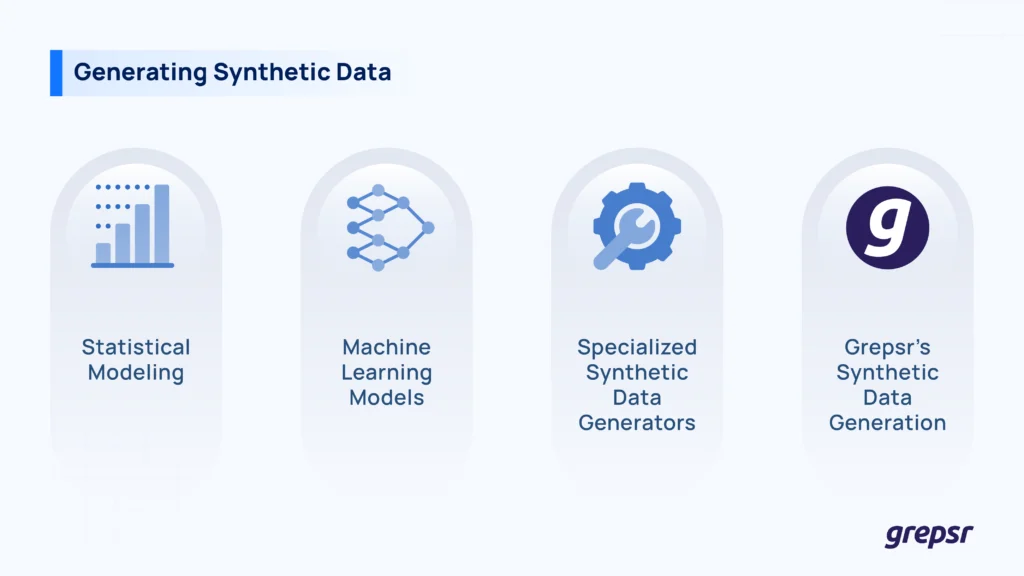
Generating synthetic data involves several methods and tools tailored to specific needs and objectives:
1. Statistical Modeling
Regression models, probability distributions, or Monte Carlo simulations can simulate data patterns. This approach can generate datasets that replicate the statistical properties of real-world data.
2. Machine Learning Models
Algorithms such as Generative Adversarial Networks (GANs) and Variational Autoencoders (VAEs) learn from real data distributions and generate new synthetic instances that are statistically similar.
3. Specialized Synthetic Data Generators
Dedicated software tools exist for specific data types, such as text, images, or tabular data. Examples of commercial tools in this space include Synthesia, Hazy and MOSTLY AI; check each vendor’s own site for what it offers.
4. Grepsr’s Synthetic Data Generation
Grepsr offers a platform for generating synthetic datasets that mimic the patterns and structure of real data. Explore it here: Generate Synthetic Data. Test any synthetic dataset for privacy risk and accuracy before sharing it.
What is the difference between partially and fully synthetic data?
Partially synthetic data replaces selected rows, columns or cells of an existing dataset with values from a statistical model. Fully synthetic data applies that approach to every row, column and cell, so there is no one-to-one mapping between original and synthetic records (NIST SP 800-188). Test data is a third type that resembles the original in structure and value range without trying to preserve its inferences.
Where is synthetic data used?
- Healthcare: developing AI-driven diagnostics with training datasets that simulate medical conditions, subject to privacy and regulatory requirements for health data.
- Retail: personalization and customer segmentation using data that mimics customer behavior.
- Automotive: training autonomous vehicle systems on simulated driving conditions and rare events that are difficult to capture in real life.
What are the risks and limits of synthetic data?
- Quality and accuracy: synthetic data must reflect real-world conditions. This takes careful modeling and validation so the generated data does not introduce bias or distort results.
- Ethical and security concerns: synthetic data must still follow ethical standards and applicable regulations.
Does synthetic data guarantee privacy?
Not by itself. NIST SP 800-226 says techniques that do not satisfy differential privacy generally provide only informal privacy guarantees and that attacks against such data have been reported, and it recommends differentially private algorithms for robust protection. NIST also notes synthetic data can reduce accuracy for sub-populations. Check privacy risk and accuracy before sharing or training on it.
Why should a business care about synthetic data?
- Cost: synthetic data can reduce the need for expensive, time-consuming data collection in some cases.
- Time to market: it can speed up testing, prototyping, and model development when it is validated for the use case.
From Concept to Competitive Advantage
Synthetic data is a useful option for teams that face data scarcity or access limits, provided privacy and accuracy are tested. To explore how Grepsr can help generate synthetic datasets for your needs, see Grepsr’s synthetic data page. Grepsr’s pricing page lists a Starter Pack from $100, priced on data records, at the time of this review (November 2026).
Related reading: Synthetic Data Generation for Enterprises: Methods, Use Cases and Limits; Why Choose Grepsr for Scalable Synthetic Data Generation: Powering AI with Reliable, Privacy-First Solutions; The Power of Synthetic Data: Revolutionizing AI and Privacy; Web Scraped Data for AI and ML Training: Use Cases, Quality and Legal Basics; How to Build AI Training Datasets with Web Scraping: An 8-Step Guide; AI Data Enrichment: What It Is, How It Works and Examples.
Frequently Asked Questions
Is synthetic data the same as anonymized data?
No. Anonymized or de-identified data starts from real records and removes or alters identifying details. NIST describes fully synthetic data as data produced so that there is no one-to-one mapping between the original and synthetic records. Even so, the privacy protection depends on how the synthetic data is generated, so it should be tested, not assumed.
What is the difference between partially and fully synthetic data?
NIST SP 800-188 describes partially synthetic data as data where selected rows, columns or cells of an existing dataset are replaced with values from a statistical model. Fully synthetic data applies that approach to every row, column and cell, so no record maps one-to-one back to the original dataset.
Can synthetic data still leak private information?
It can. NIST SP 800-226 says synthetic data techniques that do not satisfy differential privacy generally provide only informal privacy guarantees, and it notes reports of attacks that revealed the original data. NIST recommends differentially private algorithms for robust protection, so teams should evaluate privacy risk before sharing any synthetic dataset.
Does synthetic data match real data exactly?
No. A synthetic dataset attempts to keep properties of the original, such as correlations between attributes, but it is algorithmically generated. NIST SP 800-226 warns that it can reduce accuracy for sub-populations, which can introduce bias, and can make the accuracy of statistics harder to understand. Validate it against real data for your use case.
Can synthetic data be used as test data for software?
Yes. NIST SP 800-188 describes test data as data that resembles the original dataset in structure and range of values, without any attempt to make inferences drawn from it match the original. It may also include extreme values that are not in the original data but are useful for testing software.
Where can I generate synthetic data with Grepsr?
The article describes a Grepsr platform for generating synthetic datasets that mimic the patterns and structure of real data, available at synthetic.grepsr.com. Grepsr also has a synthetic data page on its main site, and the related reading section links to articles on enterprise applications and training data.

Last reviewed: November 25, 2026.