


Search here
Can't find what you are looking for?
Feel free to get in touch with us for more information about our products and services.
 Use Cases
From Product Catalogue to AI Citation: AI Prompt Monitoring for Brand Visibility at Scale
Each passing day, we users skip traditional search engines like Google and Bing for our queries.
We directly ask an AI instead, like ChatGPT, Perplexity, or Gemini, and act on whatever answer comes back, often without checking a second source.
Even when making a purchase decision, buyers rely on AI.
The response is assembled from multiple sources. Including a review site here, a competitor’s spec sheet there, and a forum thread where users have dissected the product. For buyers, that’s convenient. For brands, it’s a blind spot.
Search rank, share of search, social listening – all of it tracks a person typing a query into a search engine and scanning a page of links.
None of it tells you what happens when that same person asks an AI engine one question and gets one answer. The brand has no control or idea as to what the answer was and what the potential buyer decided.
That gap has a name now: AI prompt monitoring. It is systematically asking AI engines the questions real buyers would ask and tracking whether, where, and how a brand actually shows up in responses.
Here’s the catch, though. Collecting an AI’s answer is easy. Anyone can type a question into ChatGPT. Knowing which questions are actually worth asking, across an entire product category, at a scale that holds up over time, is a different problem entirely.
That’s exactly what this use case is about: how Grepsr built an AI prompt monitoring dashboard for a consumer audio brand.
About the client and their requirements
Our client is a global management consulting firm that advises brands on visibility and go-to-market strategy.
As AI engines started replacing search engines in how buyers research and decide, their clients began asking a question the firm didn’t yet have a clean answer for: how do we actually know what ChatGPT or Gemini says about us?
So, the firm wanted Grepsr to build a repeatable AI visibility monitoring system that can run for any brand in its portfolio. To be clear, not a single report, but a separate AI visibility measurement tool.
The non-negotiables are:
- Cover every major AI engine (ChatGPT, Claude, Gemini) that matters, not just one.
- Base the monitoring on what buyers actually ask, not what the marketing team assumes.
- Keep the prompt set current/up-to-date as the brand’s catalogue changes.
- Produce something actionable for brand and e-commerce teams, not just a visibility score.
To validate the approach before rolling it out further, the firm and Grepsr ran it end-to-end on a real case.
For a consumer audio brand, we tracked 600+ queries across six AI engines, including ChatGPT, Perplexity, Gemini, Claude, Copilot, and Google AI Overviews.
The challenges
The main challenge starts before monitoring even begins: deciding what prompts a brand should be watching.
1. Hand-written prompt sets don’t scale.
A person can maintain maybe fifty queries by hand, including writing them, checking them, and updating them as products change.
But even a single product category needs hundreds of queries. Multiply that across an entire portfolio of brands, which is exactly what the global consulting firm needed for hundreds of its clients. So, manual prompt-writing stops being a viable approach immediately.
2. Outdated prompts go stale quietly.
A product catalogue is constantly changing. Specs get updated, new models launch, old ones get discontinued. A fixed list of prompts, written once, stops matching what the brand actually sells as soon as the catalogue changes and nobody notices until the numbers stop making sense.
For example, if a prompt “best noise-cancelling earbuds under $150” was written for a product the brand discontinued months ago. Nonetheless, the dashboard keeps reporting numbers against that same query anyway. It is no longer matching what the brand actually sells.
3. They encode assumptions.
A marketer writes the questions they expect a buyer to ask, not necessarily the ones buyers actually ask.
That’s not a data problem; it’s a bias problem, and it’s invisible in the output. A dashboard built on the wrong questions still looks like a dashboard.
4. No existing tool measures this at all.
Every brand-measurement tool in use today like search rank, share of search, social listening was built for a world where people type a query into a search engine and scan a page of links.
None of it was built to track a single AI-generated answer, and there was no off-the-shelf way to retrofit them for it. This had to be built from the ground up.
The Approach
Grepsr’s solutions mirror the challenges directly. Each problem in prompt monitoring gets solved at the stage right where it begins.
1. Capture product-page data first, not prompts.
Instead of starting with questions, the pipeline starts with the brand’s own catalogue: attributes, specs, category, price and reviews pulled directly from the brand’s site or any retailer selling the product.
This is the raw material everything else gets built from. If the catalogue is accurate and current, everything downstream has a chance of being accurate and current too.
2. Let an LLM build the prompt set from that data.
Rather than a person guessing at questions, an LLM generates the query taxonomy directly from the catalogue: discovery queries, attribute and use-case queries, comparisons, brand-specific queries and problem/alternative queries.
Because the prompt set comes from the catalogue itself, it grows and changes with the catalogue. A new SKU shows up, new prompts get generated around it. A model gets discontinued, prompts stop being generated for a product that no longer exists. Nobody has to remember to update anything by hand.
3. Run that set across every engine that matters, on a schedule.
The generated prompts get run across ChatGPT, Perplexity, Gemini, Claude, Copilot, and Google AI Overviews, on a recurring cadence, capturing the full answer text and the citations behind each answer, not just a pass/fail mention.
Running it across all six, every time, is what closes the blind spot the clients ask about. A brand doing well on one engine and invisible on another is now visible either way.
4. Structure the output into a dashboard, not a report.
Every response gets broken down into mention, position, share of voice, attribute win/loss, citation sources, and trend over time. It is then illustrated in a dashboard, not a static report.
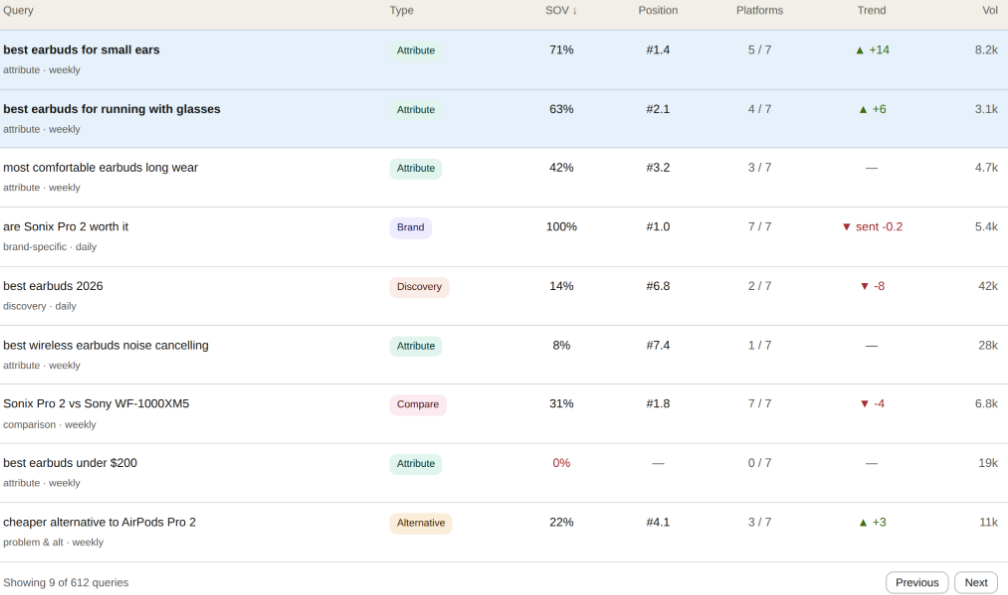
From the dashboard, a brand or e-commerce team can filter by query type, platform, or mention status; see share of voice and average position per query. Also check platform coverage at a glance (shown as, say, 4 out of 6 engines), and track a twelve-week trend for any individual query.
Click into a specific query and it breaks down further: which attributes the brand won or lost on, and the exact citations each engine drew its answer from.
That’s the difference between “the AI said something about us” and something a team can actually act on.
The outcome
Across the consumer audio brand’s 600+ tracked queries and six AI engines, the numbers looked like this:
| Metric | Result |
|---|---|
| Queries tracked | 600+ |
| AI engines monitored | 6 |
| Mentioned the brand at all | 30.6% |
| Placed the brand in the top three | 11.1% |
| Returned no mention of the brand anywhere | 51.0% |
For “Sonix Pro 2 vs Sony WF-1000XM5,” five of six engines ranked the competitor first. One ranked the client’s brand first. Same question, six different answers, depending on which engine you asked.
The attribute breakdown explains why.
The brand won on comfort, battery life, warranty, and price-to-performance. But, it lost on ANC depth, codec support, travel use case, and sound quality.
Each counted by how many engines mentioned it. Twelve citations were captured for this query alone, naming the exact pages each AI engine drew its answer from.
That level of detail is what turns the dashboard into something usable, in three ways:
- Content and product-page work. The attribute losses point directly at what the brand’s own product pages are missing or underselling. Its an opportunity as this is exactly what the models are retrieving before they answer.
- Source strategy. The citation list names the specific pages models draw on for a given query. It’s a targetable list the brand can use as references and benchmark.
- Competitive tracking. Instead of a single snapshot, the brand can watch its position on a given attribute shift over time, against a named competitor, on a schedule.
Final takeaways
Anyone can ask a model a question. That was never the hard part.
The hard part is knowing which questions actually matter. At a scale no single person can maintain, and fresh enough to keep pace with a product catalogue that’s always shifting.
AI engines are already answering questions about your brand today, whether you’re watching or not. The only choice left is whether you’re the one who finds out first, or the last one in the room to know if you or your competitor won the answer.
If your brand’s visibility strategy still ends at search rank, it’s already out of date. Talk to Grepsr about building an AI prompt monitoring pipeline that tells you exactly where you stand and exactly what to fix.

Shaping a prosperous future with data-driven decisions
Beyond the Death: Turning Obituary Data Into Fraud Detection Signals
Every year, pension funds and insurers pay out benefits to people who are no longer alive to receive them. The infrastructure meant to catch a death hasn’t caught up yet, so checks keep getting cut and policies stay active while the record goes unverified. The Social Security Death Master File (DMF) is the default source […]

Competitor Location Monitoring at Scale: Tracking Dealer Network Change Over Time
Markets shift constantly, and most of that shifting happens quietly. A competitor expands into a new region, pulls back from another, and neither move comes with an announcement. For a manufacturer trying to track where rivals are gaining ground, the only real signal is where their dealers show up next. But here’s the thing: a […]

The Hidden Number: How Grepsr Cracked Real-Time Stock Data for a Major Retail Network
Some websites don’t hide their data behind a locked door; they hide it behind a maze. A major retailer’s stock levels were never listed anywhere on its site; the only way to find the real number was to keep adding items to a cart until it broke. This is how Grepsr turned that breaking point […]
The Data Marathon: How Grepsr Keeps Millions of Health Insurance Records and 350+ Data Pipelines Flowing
A partnership story from the health insurance data industry When a New York-based health insurance data and API platform set out to build a standardised data layer for the employee benefits industry, the product vision was straightforward: Give brokers, benefits administrators, and health insurance carriers a single, standardised data layer including provider networks, plan details, […]
Web Scraping for Competitive Market Insights: Powering $3 Billion in EBITDA Through Data-Driven Pricing
Setting prices for products is similar to adjusting the sails on a boat. If you don’t read the wind properly, you’ll either be stuck in place or heading in the wrong direction. Data is the wind that helps you steer a steady course. In an economy where every dollar counts, businesses can’t afford to guess […]
Web Scraping for Drug Safety Monitoring: Real-Time Data Extraction for Tracking Side Effects
Quick Summary: Web scraping and public web data extraction can help pharmaceutical companies detect drug side effects faster by monitoring publicly available discussions and medical publications. This case study explains how a pharma company used web scraping to collect real-time signals about adverse drug reactions and turn scattered public information into structured safety data. Imagine […]

Analyzing Celebrity Impact on Consumer Behavior through Social Media Data: Taylor’s Version
This case study takes a deep dive into the powerful influence of global pop star –Taylor Swift. By extracting social media data using carefully selected keywords and hashtags, we analyze patterns and trends that reflect the powerful gravitational pull of her influence on consumers. Continue reading for jaw-dropping insights. The Power of Celebrity Influence Celebrities […]
Boosting Efficiency and Accuracy: The Power of AI Data Validation for E-commerce Growth
In e-commerce, one wrong product detail can cost you a sale, or worse, a customer’s trust. As businesses scale, ensuring the accuracy and consistency of their data becomes an increasingly complex challenge. Similarly, for a growing electronics retailer, managing an expanding catalog of products with manual data validation was a recipe for errors, delays, and […]
How Proactive Communication Scaled a Product Data Extraction Project for a Dental Supplier
The dental products retail industry is thriving in the online business sector. As more dental professionals turn to digital platforms for sourcing products, those who can harness the power of big data are gaining a competitive edge. One of the most effective ways to leverage this data is through product data extraction—the process of automatically […]
How a Leading Consumer Electronics Company Leveraged Automated Customer Review Extraction
Customer reviews serve as the backbone of product development and consumer insights. For one leading consumer electronics brand, these reviews were essential for fueling machine learning models that perform sentiment analysis and inform key business decisions. However, the frequent removal of reviews by platforms due to policy violations creates significant challenges, leaving gaps in the […]

Powering a Booking Intelligence System with Real-Time Hotel Data Extraction
In the travel industry, booking data is the pulse that reveals how markets move. It captures the patterns of demand, competition, and consumer intent like who’s booking, where, when, and at what price. This information fuels dynamic pricing, helps forecast occupancy, and enables travel platforms and hotels to anticipate market shifts rather than react to […]
How ESG Advisory Firms Can Leverage Automated Article Extraction for Smarter Insights
Government websites and official press releases are goldmines for ESG (Environmental, Social, Governance) intelligence. Every update – whether it’s a new regulation, policy amendment, or court directive can shape how ESG advisory firms advise their clients. Yet, these updates are scattered across hundreds of government portals, each with its own format, language, and publishing schedule. […]

Seamless Vehicle Data Extraction for a Leading Automotive Intelligence Provider
In the automotive industry, having access to comprehensive, real-time vehicle information is essential for making informed decisions. However, gathering this data from online sources comes with many challenges, such as security barriers, IP restrictions, and complex firewall configurations. These can significantly disrupt the flow of critical data needed to support key business operations. In this […]

High-Coverage POI Data Extraction For Powering FMCG Market Strategy
Finding the right retail locations is a lot like navigating a city without street signs – you might eventually reach your destination, but not without wasted time, missed turns, and lost opportunities. Points of Interest (POI) data acts as those street signs, offering clear visibility into where consumers shop, dine, and gather. For global brands […]
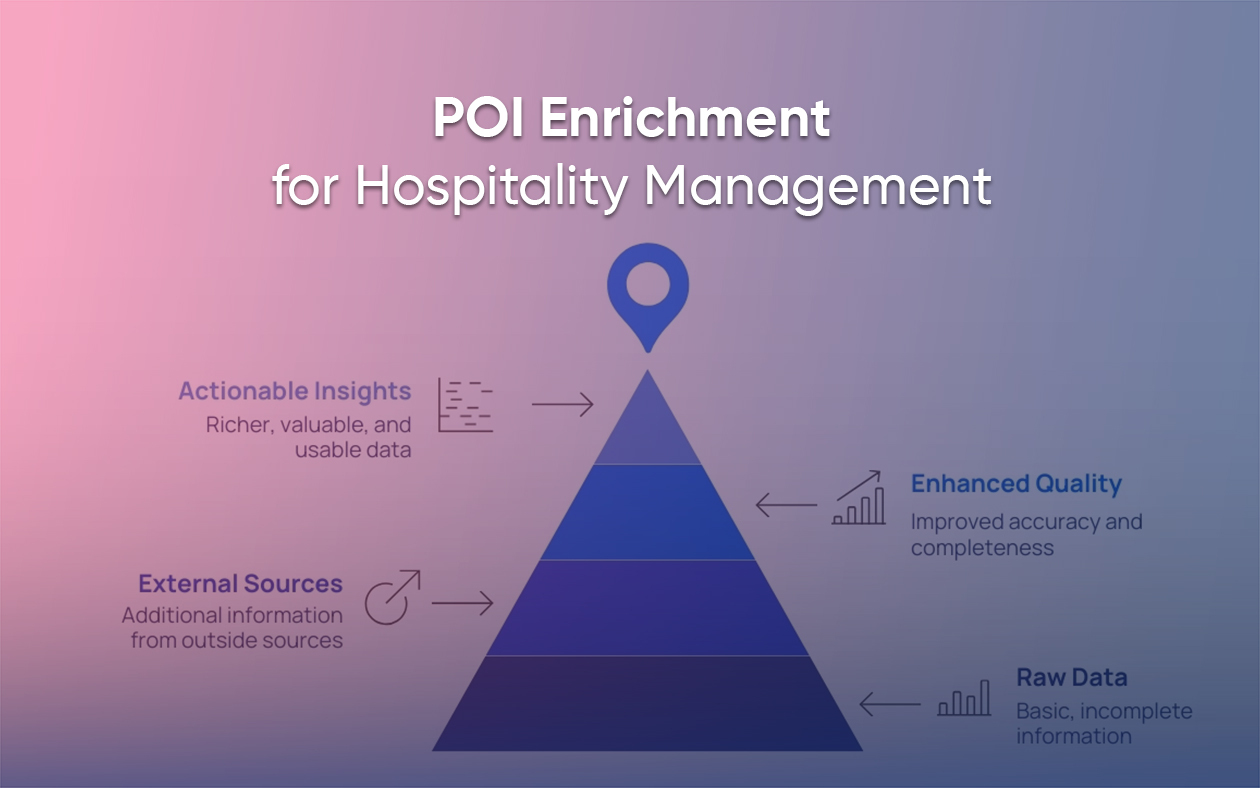
POI Data Enrichment for a Leading Hospitality Management Company
Data is valuable, but enriched data is priceless. Data enrichment is the process of adding value and further information to an existing dataset to improve its quality, accuracy, and completeness. It involves taking raw, incomplete data and enhancing it with additional and meaningful information from external sources. It turns a basic dataset into something richer, […]
Top Six E-commerce Datasets: Web Scraping Use Cases
The irreversible rise of e-commerce has been a similar phenomenon around the world. In 1998, the entirety of the e-commerce market stood at just $5 billion.
Location Intelligence in Retail: Real Use Cases From Grocery Stores
Do you know what separates successful retailers from the ones that are closing down? One key factor is using location intelligence in retail to make informed decisions. Modern retailers scrape the internet to find out competitor store hours, demographic shifts, and foot traffic patterns to find impactful location strategies. And the numbers back it up. […]
Shaping Organizational Culture with Glassdoor Data
Glassdoor Data offers a detailed look into organizational culture by analyzing employee reviews and ratings. This data provides insights into company dynamics, regional trends, and the impact of major events, helping businesses improve employee satisfaction and cultural alignment. Netflix’s culture deck, crafted by Reed Hastings, champions employee autonomy and creativity, even offering unlimited vacations as […]
How Web Scraping Saved a Vehicle Data Platform
How Grepsr rescued a vehicle data platform from a major OEM block—restoring 100% uptime, 99.9% data accuracy, and real-time API performance for VIN checks and insurance quotes.
Mapping LA Wildfire Impact with POI Data
POI data extraction and reverse geocoding transformed wildfire impact maps into precise addresses, enabling targeted disaster relief.
How a Real Estate Agency Gained Competitive Intelligence with Real-Time High-Quality Datasets
Gathering structured real estate data from various government sites and public records at scale poses significant challenges.

What Is Shipping Data & Why It’s Critical for Logistics Performance
Before the pandemic, the global supply chain relied on predictable inventory flows. There was high schedule reliability, which meant the carriers usually followed the same schedules. This ensured the arrival of inventory in time, replenishment of stores, and constant operation of the factories.
Unraveling Job Market Dynamics: Leveraging Data Analytics for Competitive Edge
The notion of hiring the “right” candidate needs clarification of what’s “right” for your organization. Starting from the alignment of values, motivation, ambition, and technical skills required for the position.

Enabling Market Expansion: Data Refinement at Grepsr
Any data is only as good as the insights derived from it. However, before we begin the analysis, the data must be put through adequate pre-processing techniques that standardize, aggregate, and categorize the dataset.

Introduction to Web Scraping & RPA
Web scraping automatically extracts structured data like prices, product details, or social media metrics from websites. Robotic Process Automation (RPA) focuses on automating routine and repetitive tasks like data entry, report generation, or file management.

Car Rental Data Unwrapped: Merry Miles and the Christmas Story in the UK
Delve into the festive drive as we analyze 50K+ car rental records from ‘Sixt – Rent a Car’ during December 2023. From the holiday surges on Christmas Eve to discovering budget-friendly gems like the Kia Picanto, come with us as we decode the Merry Miles of Christmas car rentals in the UK.
NYC POI Data Dynamics: Decoding Impermanence
Geographical locations or POIs are not entities that last for posterity. We collected NYC POI data to decode the various dynamics that may help executives make informed decisions within the backdrop of impermanence.
Revving Up for E-commerce Success in Q4: Leverage Web Scraping
Inflationary pressures, rising prices, and the looming possibility of an impending recession have dealt an unwarranted blow to e-commerce sales over the last three quarters.

Harnessing POI Insights: The Web Scraping Advantage
Points of Interest (POIs) are more than just points on a map. They are filled to the brim with actionable data like addresses, names, contact details, and working hours. POI data also includes images, which add a visual component to the data. With web scraping, you can get the advantage you need to harness POI insights.
Analyzing US Job Postings Data to Understand Job Market & Economy
The US economy was forecast to spiral into a recession in 2023. Yet, despite fears, if current job listings and hiring trends are to be believed, the current economic reality appears to be quite different. The robust nature of the current US job market is proving to be one of the main drivers of the country’s strong economy.
