Pline is a web scraping API from Grepsr that returns clean markdown, structured JSON, or clean HTML from any site, including the protected ones that block other scrapers. You’re billed only when a request succeeds.
It went live on October 12, 2026, and it’s free to start with no card required.
If you’ve ever shipped a scraper, you know how the story goes.
Why most web scraping APIs break on protected sites
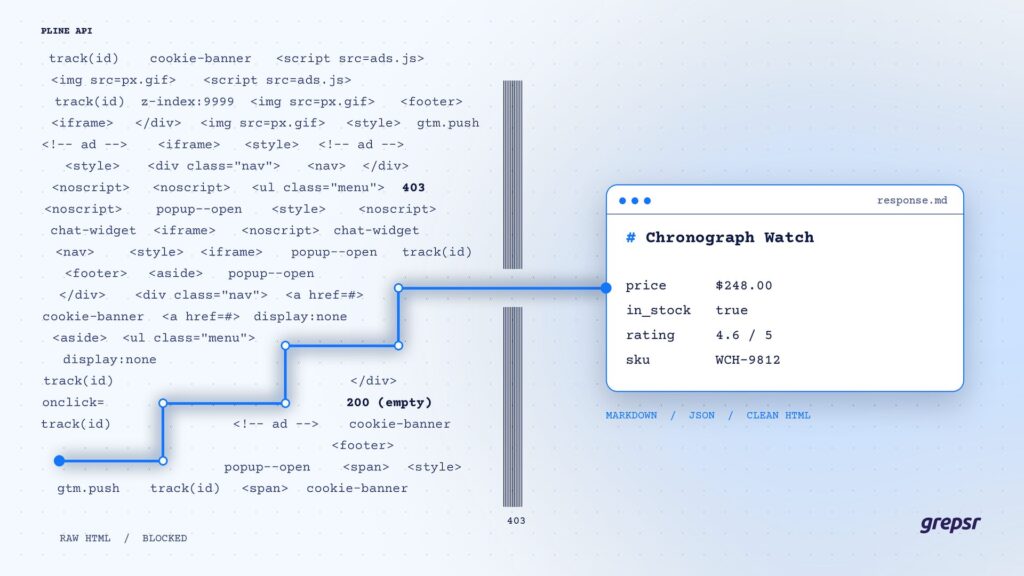
Most scraping tools work fine until they meet a site that doesn’t want to be read. Then you get a 403. Or an empty page. Or, worse, HTML that looks right and isn’t.
So you write retry logic. You buy a proxy plan. You bolt on a headless browser. Six weeks later you’re maintaining infrastructure instead of building your product.
We’ve been on the other side of that problem for 14+ years. Grepsr runs managed web data extraction and now handles 10 billion pages a month. Sites change, defences get harder, and we fix it before customers notice. That’s the job.
Pline is what happens when you take that experience and build an API-first product from scratch. New code, its own docs, its own pricing, its own roadmap.
But it ships on day one knowing things most scraping APIs learn the expensive way: which sites need the heavy approach, where to stop trying, and what a page looks like when it returns 200 and lies to you.
Reliability: pline API keeps going until the page comes back
A request starts on the lightest approach that should work. If it gets blocked, Pline steps up to a stronger one, and keeps stepping up until the page loads. You don’t choose a mode, pass a flag, or rewrite your call.
Our core infrastructure operates at a 99% uptime level. By our numbers, 95% of requests come back successful. The average response time is 3 seconds. That’s slower than a tool that fails fast, and it’s deliberate. A hard page is worth waiting for, and when a light fetch works, you get it sooner.
(Both figures are our own, so test them against the site that’s currently giving you trouble. That’s what the free tier is for.)
You pay for results, not attempts
Blocked, timed out, returned empty: not billed.
This matters more than it sounds. Most scraping APIs charge for the attempt, which means the harder the site, the more you pay to not get data. We bill the result. If our escalation is bad, we absorb the cost, not you. It keeps us honest.
Output built for a model, not a parser
A typical product page is nav bars, cookie banners, tracking scripts, footer links and a chat widget, with the four fields you wanted buried somewhere inside.
Feed that to an LLM and two things happen: you pay for thousands of tokens of markup, and the model has to find the signal before it can answer anything. Accuracy drops while cost rises.
Pline strips the page before it reaches you. You pick the shape:
- Markdown: the readable content with its structure intact, ready to drop into a prompt.
- Structured JSON: the fields you asked for, typed and consistent, ready for a database or function call.
- Clean HTML: markup without the noise.
Token costs fall because clean markdown is a fraction of the raw HTML. And because the output shape is the same across every domain, your code stops being per-site. A new source gets the same handler.
Four endpoints
- Scrape: one URL in, clean content out.
- Crawl: a starting URL in, every page it can reach out.
- Map: lists a site’s URLs without fetching the pages, so you know how big a job is before you start it.
- Batch scrape: many URLs as one job, with results collected together.
There’s also an MCP server and a CLI skill installer. Point an agent at the MCP server and it gets web access with no wrapper code and no prompt engineering around a wall of div tags. The content it receives is something it can reason about on the first response.
pline or Grepsr?
Different tools for different jobs. Pline API is for developers who want real-time web data and prefer to build the thing themselves: an agent, a pipeline, a product you’re shipping.
Grepsr’s managed service is for teams who’d rather hand off extraction entirely and let us handle it when sites change.
Pline is a separate product, so your Grepsr services stay as they are. And if your needs grow beyond self-serve, we’re already here.
Try it on the site that’s breaking your scraper
The free tier is enough to run a real test. If it works, paid plans start at $14/month. If it doesn’t, tell us which site and we’ll look at it. That’s been our job for 14 years.
Pline went live on October 12. Get your API key at PLINE API.
FAQ
What is Pline?
Pline is a web scraping API by Grepsr with four endpoints (scrape, crawl, map, batch scrape) that return markdown, structured JSON, or clean HTML.
How does Pline handle sites that block scrapers?
It escalates automatically. Each blocked request moves to a stronger approach until the page returns, with no flags or configuration on your side.
Am I charged for failed requests?
No. Blocked, timed-out, and empty responses aren’t billed.
Can I use Pline with AI agents?
Yes. Pline offers an MCP server and a CLI skill installer, so agents can fetch web content without custom wrapper code.
How much does it cost?
Free to start, no card required. Paid plans start at $14/month.