Big Data — data so big we invented new words like zettabytes to measure it.
Over 5 billion of us use the internet daily — and like muddy car tires, we leave tracks everywhere — our digital footprint. Whether it’s a quick Google search, posting on Instagram, or how long we spend watching Parks and Recreation on Netflix; all of this information is tracked, stored, and analyzed.
Think of Big Data as a snowball rolling down a hill. In 1999, the term referred to just one gigabyte. Today, that snowball is the size of a mountain, or even a continent. You could stack all the data created in just one day on top of each other and reach the moon. Twice.
But what does the industry look like from a numbers perspective? In this blog, we’ll cover 31 amazing statistics about Big Data from industry-specific facts to market projections and trends.
Buckle in, we’re going to the moon!
Key Takeaways: The Numbers That Matter Most
Here’s what you need to know before we get into the details:
- 221 zettabytes of data will be generated globally in 2026 — a 22% jump from last year.
- The Big Data analytics market has crossed $450 billion and is heading for $1.4 trillion by 2034.
- 97% of businesses have invested in Big Data. Fewer than 40% are using it effectively.
- Netflix saves $1 billion every year through Big Data-driven customer retention.
- Big Data in healthcare is projected to reach $644 billion by 2035.
- 6 billion people — 73% of the world — are online and generating data right now.
Big Data Growth Statistics (2026)
- Around 221 zettabytes of data will be produced globally in 2026 — a 22% increase year-over-year. By 2032, the global datasphere is projected to reach 924 zettabytes. (Statista)
- The Big Data analytics market was valued at USD 454.00 billion in 2025 and is projected to grow from USD 521.09 billion in 2026 to USD 1.4 trillion by 2034, registering a CAGR of 13.30%. (Fortune Business Insights)
- How many organizations are investing in Big Data and AI? A whopping 97%, yet only 40% use analytics effectively. (Demand Sage)
- The major challenge facing businesses today is collecting high-quality, real-time data at scale. If you’re ready to make the shift from reactive to proactive data, we can help you with our automated data extraction services!
- Big Data in business intelligence applications will reach $63.5 billion by 2028. (Global Big Data Markets Analysis Report)
- In 2025, 463 ZB of data will be created daily, and the Big Data market will be worth $229.4 billion. (Finances Online)
Now, let’s zoom in just a little — narrow our focus to the everyday.
How Much Data is Generated Every Minute?
What happens in sixty seconds on the internet every day? How much data do we generate?
Thanks to our friends at Domo who published their 11th report on Data Never Sleeps, we have an eagle’s eye view of what’s happening in just sixty seconds on the internet:
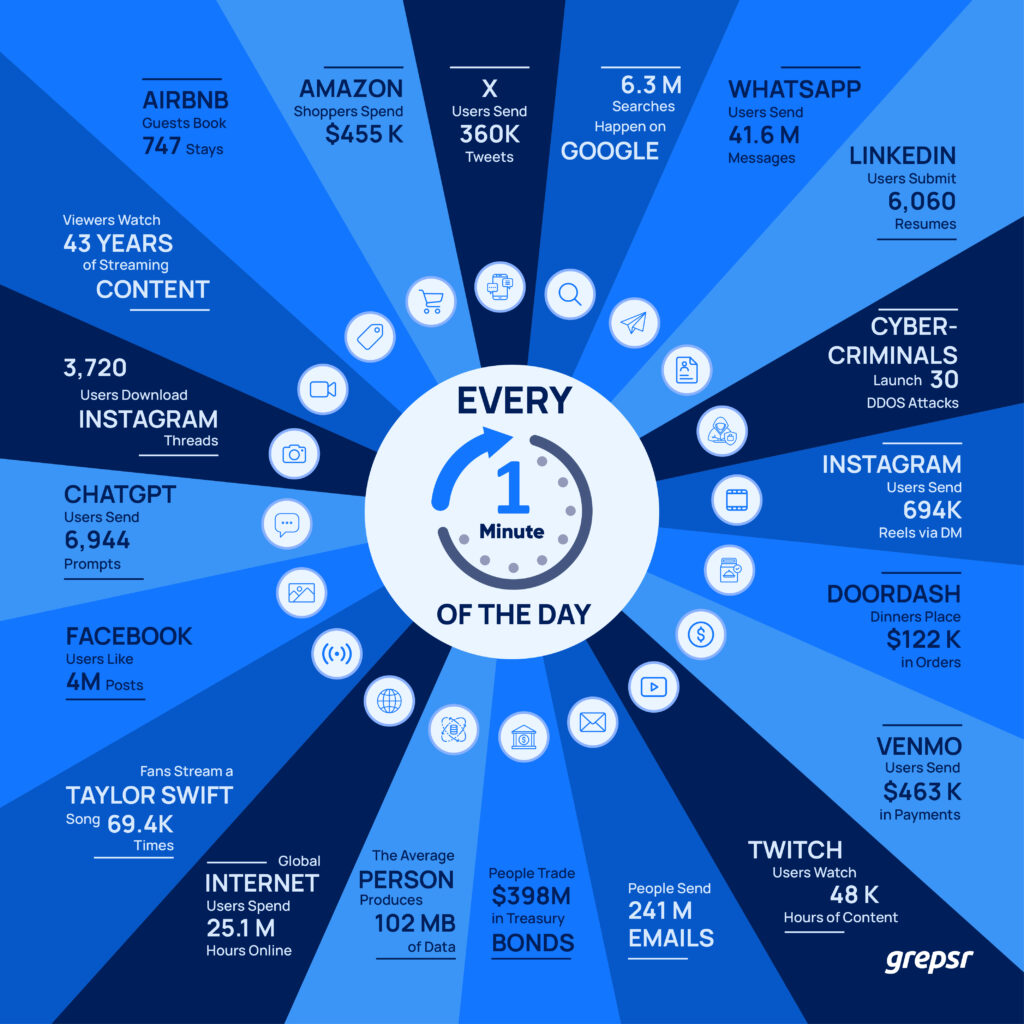
- Emails sent: 241 million.
(That’s six zeroes, in case you were wondering.)
- LinkedIn resumes submitted: 6,060.
(Thanks to Easy Apply, eh?)
- WhatsApp messages sent: 41.6 million.
- Number of times fans stream a Taylor Swift song: 69,400.
You’re probably thinking, “Sure, these statistics about Big Data are staggering, but what do they actually mean for me and my business?”
Each email reveals professional communication preferences. Resumes highlight career priorities. A massive volume of messages indicates the dominance of real-time digital interactions. There’s even a window into viral pop culture moments in music streams.
All of this is to say that leveraging Big Data is your competitive advantage to provide better service to your customers.

Big Data Market Forecasts and Predictions: 2026-2032
You can boost your profits by 25% by increasing your customer retention by just 5%. No, really.
In a world of anonymized numbers, customers are swayed by how well their favorite brands know them and can respond with timely and relevant content.
Enter, personalized customer journeys.
Enter, real-time customer data.
Enter, Grepsr.
- Refined customer analytics increase customer loyalty and retention by 58%.
- When enterprises adopt and integrate customer analytics into their operations, 44% gain new customers and increase revenue.
- Think of real-time data as powering bespoke designs for your customers in a market full of off-the-rack choices. They get the personalized experience, you get their repeat business. Win-win.
- Analyzing real-time customer data delivers the greatest business value in two areas: improving customer experiences (85%) and driving customer retention and loyalty (58%).
- Netflix saves $1 billion a year by using Big Data to retain customers. (CMS Wire)
- To put it into perspective, that’s the same as giving every Netflix subscriber a free month of streaming.
Big Data’s Big Impact on Business Performance
Can Big Data improve business performance? According to these Big Data statistics, the answer is a heck yes:
- Businesses that invest in data and analytics report a profitability or performance increase of at least 11%. (KPMG Global Tech Report 2023)
- The top benefits of Big Data are better strategic decisions (69%), improvements in operational processes (54%), and a better understanding of customers (52%). The organizations that can quantify their gains from analyzing Big Data report an average 8% revenue boost and 10% cost reduction. (BARC)
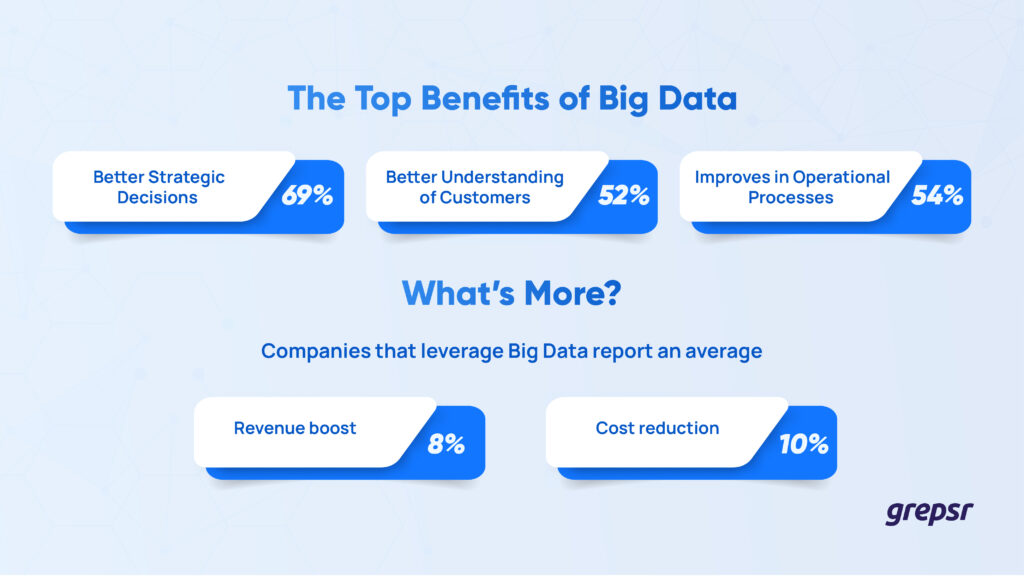
- These statistics about Big Data are our favorites. Why? Because these quantifiable metrics prove just how valuable collecting data is — from the right sources, and with the right technologies. This is where we come in.
- 54% of organizations with advanced data and analytics maturity have increased their revenue, and another 44% have achieved a competitive advantage. (WNS)
The question then becomes: how do these Big Data statistics translate into real-world efficiencies?
The Big Data Way to Streamline Operations
- UPS optimized routes using Big Data and machine learning, reducing fuel consumption by 10 million gallons and emissions by 100,000 metric tons. (Forbes)
- That’s the equivalent of taking 21,000 cars off the road each year. A big win for UPS’s bottom line perfectly aligned with their sustainability initiatives.
- How many pizzas does Domino’s deliver in a day? Thanks to Big Data — three million. (Restaurant Business Magazine)
- That’s a lot of pizza — enough to make Italy blush. Domino’s online orders accounted for 70% of sales in the US, and delivery times averaged less than 30 minutes.
Next up: how Big Data is exploding in the retail, healthcare, finance, and real estate industries.
Industry-Specific Statistics About Big Data
Big Data in Retail:
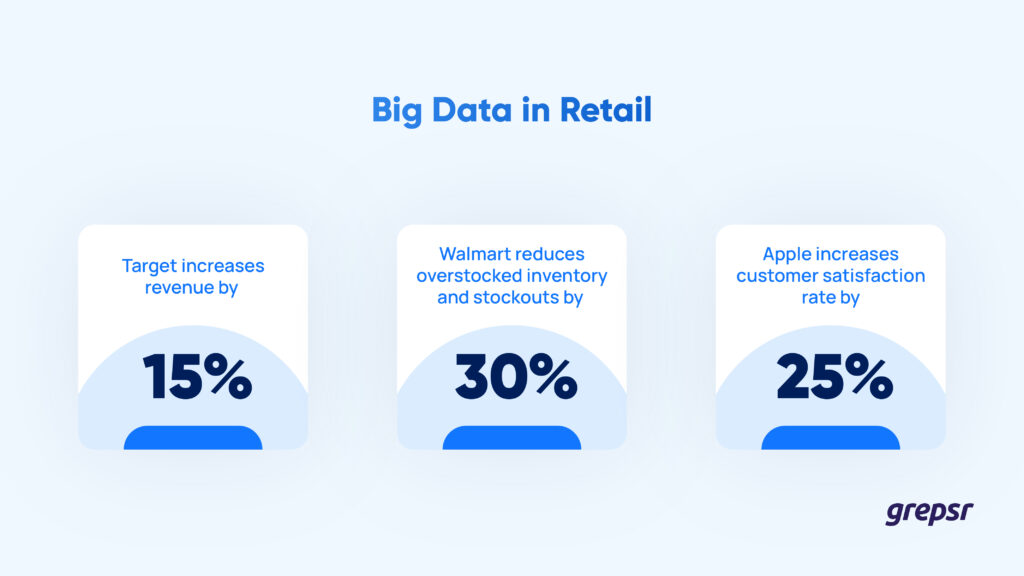
- Global revenue at Target increased by 15% within a year after implementing Big Data-driven price optimization. (Turing)
- Walmart’s implementation of data-driven demand forecasting resulted in a significant reduction in overstocked inventory and stockouts by 30%. (Grepsr)
- This example is proof of how retailers can improve their inventory management and reduce waste by using Big Data. Looking to make smart, data-driven decisions? Grepsr’s managed data extraction and web scraping services can help your business gather the proactive data you need to make informed business choices.
- Similarly, using Big Data, Apple has seen a 25% increase in customer satisfaction ratings across its various devices over the last year. (Digital Information World)
Big Data in Healthcare:
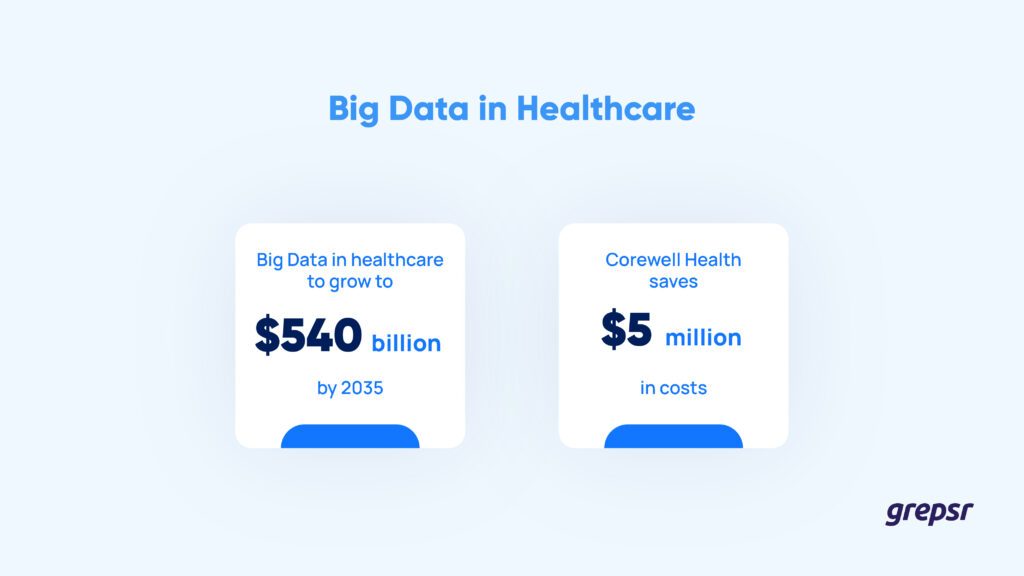
- The market size for Big Data in healthcare is projected at USD 110.97 billion in 2025 and is expected to reach USD 644.8 billion by 2035, growing at a CAGR of 19.24%. (Towards Healthcare)
- Think, improved patient outcomes, more accurate health forecasts, optimized clinical trials, and better remote monitoring.
In fact…
- Big Data at Corewell Health has decreased readmissions by 200 patients and saved $5 million in costs. (Spectrum Health)
Big Data in Finance:
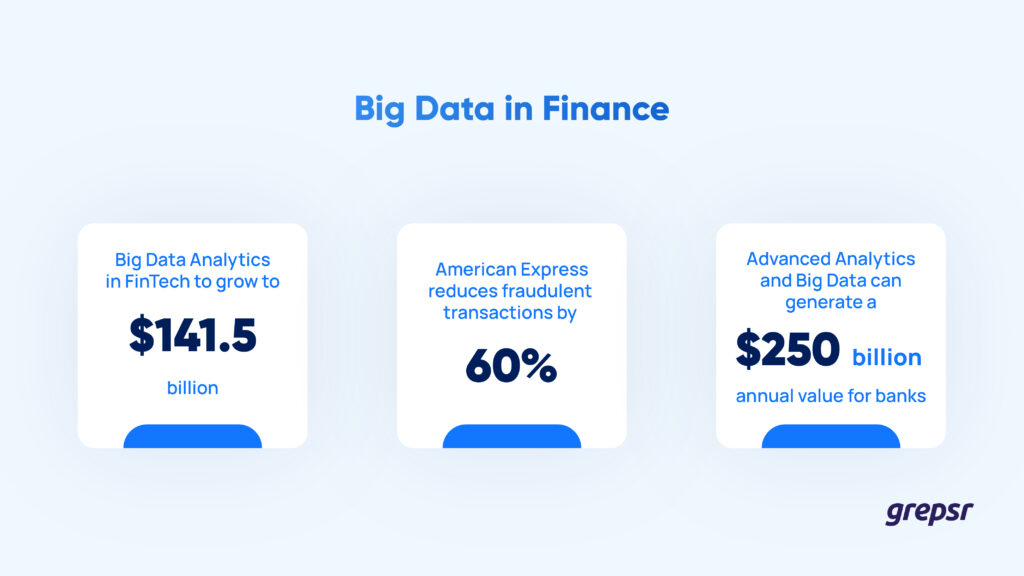
- In 2026, the market for Big Data analytics in FinTech is projected to grow to $141.5 billion. (Zipdo)
- Big Data has helped American Express reduce fraudulent transactions by 60%. (Harvard School of Business)
- When you can analyze massive datasets in real time, consumer behavior and transactional trends become easier to track, monitor, and analyze. The result? Reduced fraud, better process optimization, and enhanced security.
- Meanwhile, advanced analytics and Big Data can generate a $250 billion annual value for banks. (Zipdo)
Big Data in Real Estate:
- Among respondents, 30% think automation will have the biggest impact on real estate in the short term, while 27% think Big Data and data analytics will. (KPMG)
- Imagine being able to sell more houses by painting your bathroom walls a particular shade of blue. That’s the power of Big Data in real estate.
- Forecasts from 2020 to 2027 show that predictive analytics adoption in real estate will increase at a rate of 23.8%. (Times Tech)
We promised you the moon. We’re almost there…
Statistics About Big Data’s Future
- By 2028, the global Big Data analytics market is forecast to reach $549.73 billion. (Fortune Business Insights)
- That’s more than the combined GDP of Norway, Ireland, and Portugal! (We did the math.)
- By 2025, approximately 30% of the global datasphere became real-time data — and that share continues to grow in 2026 as IoT device counts surpass 19 billion. (Demand Sage)
- The number of consumers interacting with data is growing —More than 6.04 billion people use the internet worldwide as of early 2026, representing approximately 73.2% of the global population. (Demand Sage)
In (Big) Data We Trust
The statistics about Big Data tell a compelling story, don’t they? From healthcare to retail to finance, the numbers don’t lie.
However, with Big Data, comes big responsibility. So, wherever you are on your data journey, you need secure, real-time business intelligence that helps you make data-driven decisions and boosts operational efficiency.
The future belongs to those who can ride the Big Data wave — and with us, you never have to worry about getting left in the dust. Get in touch today to discuss your business’s needs!
Frequently Asked Questions About Big Data
How much data is generated every day in 2026?
Approximately 2.5 million terabytes of data are created every single day — that’s 29 terabytes every second. Annually, this adds up to around 221 zettabytes globally. To put it simply: the world is generating more data this year than it has in all of human history combined.
How big is the Big Data market in 2026?
The Big Data technology market is valued at approximately $521 billion in 2026 and is projected to reach $1.4 trillion by 2034, growing at a 13.3% CAGR. The analytics segment alone has crossed $348 billion. (Fortune Business Insights, 2026)
What percentage of businesses use Big Data?
Over 97% of businesses have invested in Big Data and AI initiatives — but fewer than 40% are currently using analytics effectively. The data is there. The gap is in knowing what to do with it.
How is Big Data used in retail?
Retailers use Big Data for demand forecasting, price optimisation, inventory management, and personalised customer experiences. Walmart reduced overstocked inventory and stockouts by 30% using data-driven forecasting. Target saw a 15% revenue increase after implementing Big Data-powered price optimisation.
How does Big Data impact healthcare?
Big Data in healthcare is valued at $132 billion in 2026 and projected to reach $644 billion by 2035. It’s being used for patient outcome prediction, readmission reduction, clinical trial optimisation, and personalised medicine. Corewell Health used analytics to prevent 200 readmissions and save $5 million in costs.
How does Big Data improve customer retention?
Real-time customer analytics improves loyalty and retention by 58% and helps 44% of enterprises acquire new customers. Netflix saves $1 billion every year using Big Data to keep subscribers from cancelling — that’s the equivalent of a free month of streaming for every subscriber on the platform.